

84% of travelers say they are building trips around personal passions and immersive experiences in 2026.
In Vilnius, that shift isn’t a trend. It’s a tradition.
For three days every March, the entire Old Town transforms into something rare in modern Europe: five kilometers of living craftsmanship. Not a staged market. Not a curated Instagram setup. A real, working artisan fair where 1,200 certified craftspeople take over the streets.
This is Kaziukas Fair — one of the oldest open-air craft fairs in Europe.
And it’s not something you observe. It’s something you step into.
A City That Turns Into a Workshop
From March 6–8, 2026, Vilnius becomes an open studio.
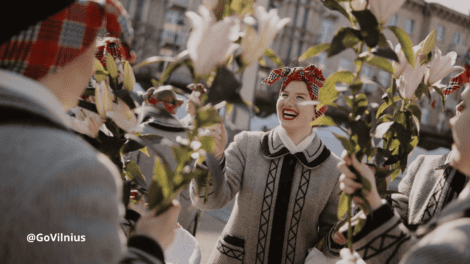
Walk through the Old Town and you don’t just see ceramics, leatherwork, glassware, and Baltic jewelry — you hear iron being shaped, see potters’ wheels spinning, watch woodcarvers working with slow precision.
There is no separation between maker and visitor.
You can learn to weave.
You can shape clay.
You can bake šakotis — Lithuania’s iconic tree cake — over an open flame.
The aromas of smoked fish, fresh bread, and slow-cooked cepelinai drift through the streets. Musicians in traditional dress play folk melodies not for tourists, but because this is what this weekend has always sounded like.
This is craft tourism in its purest form: hands-on, community-driven, culturally intact.
More Than a Market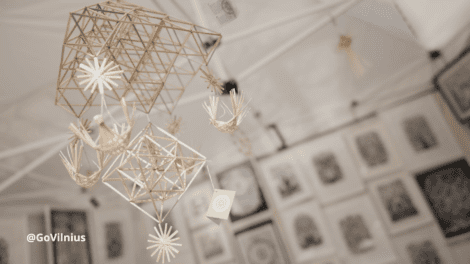
This year introduces two powerful focal points. At Cathedral Square, Dzyvų Alėja (Alley of Life) brings together artisans and food producers from all five Lithuanian ethnographic regions — a symbolic gathering that reflects the country’s cultural depth in one place.
In nearby Šventaragio Valley, the Avilys creative collective transforms the space into an interactive craft hub. Here, visitors can watch blacksmiths, jewellers, and woodcarvers at work — and then try the techniques themselves.
This is not performance.
It’s participation.
Three Traditions You Won’t Find Anywhere Else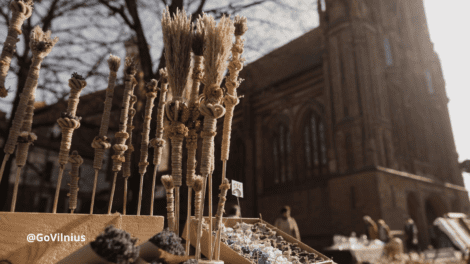
Among hundreds of crafts, three stand out as distinctly Lithuanian.
Sodai (Straw Gardens)
Delicate geometric ornaments symbolizing the World Tree. Recently added to UNESCO’s Representative List of Intangible Cultural Heritage, they are both meditative art and cosmology in motion. While intricate originals are fragile, DIY kits allow visitors to recreate the experience at home.
Verbos (Easter Palms)
Since palm trees don’t grow in Lithuania, artisans create vibrant Easter palms from willow branches, dried flowers, and native plants. At Kaziukas Fair, you can not only buy one — you can make your own.
Šakotis (Tree Cake)
Baked slowly by dripping egg-rich batter onto a rotating cylinder over open flame, this pine-shaped cake is traditionally reserved for major celebrations. At the fair, you can watch the process — and in some workshops, try it yourself.
Why This Matters in 2026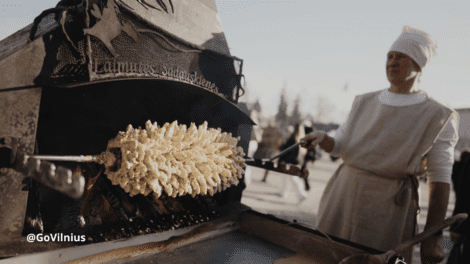
According to global travel trend reports, over 70% of travelers are seeking deeper cultural immersion.
Kaziukas Fair isn’t adapting to that demand. It has always embodied it.
This is not a curated “experience package.”
It is a centuries-old celebration where visitors become temporary participants in local tradition.
For travelers seeking meaning over spectacle, craft over consumption, and connection over checklists — Vilnius in March offers something genuinely different.
Getting There
Vilnius International Airport (VNO) connects directly to over 60 European destinations, including London, Amsterdam, Paris, Milan, Barcelona, Munich, and Oslo. The airport is just 20 minutes from the Old Town — and from the heart of the fair.